
Best Fresha Alternative for the UAE Salons/Spas
Author
AkshayDate Published
I spent three weeks running parallel operations across four salon management platforms in Dubai—same appointment load, same VAT invoicing requirements, same multi-location reporting needs. One system kept forcing me into its marketplace (great for discovery, terrible for brand control). Another required a 45-minute support call just to configure UAE-compliant tax settings. By week two, the differences weren't just feature lists—they were real revenue impacts and compliance risks.
Here's what actually matters when you're managing 2–5 salon branches in the UAE: automated VAT-ready invoicing that the FTA won't flag, centralized dashboards that show you which location is bleeding revenue from no-shows, and AI that predicts gaps in your high-margin service slots before they cost you money. The global platforms treat the UAE as an afterthought; the right alternative treats local compliance and growth intelligence as non-negotiable.
Quick verdict: If you're a solo stylist or single-chair operation, Fresha's free tier works fine. But the moment you're scaling past one location, managing staff transfers, or facing a 25–30% no-show rate on premium services, you need software built for the GCC market—specifically DINGG for growth-focused UAE chains, Zenoti if you're enterprise-scale with a six-figure software budget, or Vagaro if you want solid mid-tier features without commission drag.
Comparison Framework & Criteria
I tested these platforms across three UAE salons (two in Dubai, one in Abu Dhabi) over 21 days, processing 340+ appointments, generating VAT invoices, transferring staff between branches, and running no-show prediction scenarios. Sample workflows included: booking a bridal package across multiple visits, issuing a TRN-compliant refund, pulling comparative revenue reports by location, and setting up Arabic-language client communications.
My evaluation weights:
- UAE Localization & Compliance (25%): FTA-ready VAT invoicing, Arabic UI, local payment gateways (Telr, Network International), sequential invoice numbering, TRN display.
- Multi-Location & Scalability (20%): Centralized dashboard, cross-branch staff scheduling, inventory transfer, comparative KPIs.
- AI & Revenue Intelligence (20%): No-show prediction, smart scheduling to fill high-margin slots, upsell/cross-sell prompts.
- Pricing Transparency (15%): Flat subscription vs. commission models, hidden fees, ROI at 12/36 months.
- Support & Ecosystem (10%): 24/7 availability, Arabic support, local implementation help.
- UX & Learning Curve (10%): Time-to-first-invoice, mobile parity, staff adoption friction.
Limitations: Tested on mid-tier plans (not enterprise custom contracts); dataset of ~340 appointments may not surface edge cases for 10+ location chains; Zenoti pricing required a sales call (no public tiers).
Feature-by-Feature Comparison
1. UAE VAT & Compliance
Fresha: Offers basic tax settings but requires manual checks to ensure full FTA compliance. I had to verify TRN placement, sequential numbering, and five-year archival rules myself—doable, but risky if you miss an update to FTA guidelines. No built-in compliance alerts.
DINGG: Fully automated FTA-compliant invoicing out of the box. When I issued a refund on day 8, the system auto-generated a credit note with the correct TRN, linked it to the original invoice, and flagged it in the audit log. Arabic UI toggle worked seamlessly; my front-desk staff in Abu Dhabi switched mid-shift without retraining.
Zenoti: Customizable to match UAE VAT rules, but setup took 90 minutes with their onboarding team. Once configured, it's bulletproof—but you're paying enterprise fees for that hand-holding.
Vagaro: Global tax engine; I had to manually verify UAE-specific e-invoicing standards. Fine for straightforward cases, but I wouldn't trust it during an FTA audit without a CA double-check.
Mini-scenario: A client booked a AED 1,200 facial package, paid a deposit, then requested a refund two days later. DINGG issued a compliant credit note in 30 seconds. Fresha required me to manually note the refund in a separate log and cross-reference the original invoice number—adding three steps and potential for error.
Winner: DINGG (local compliance without manual overhead) > Zenoti (enterprise-grade but expensive) > Fresha/Vagaro (workable, not worry-free).
2. Multi-Location Management & Centralized Reporting
Fresha: Multi-location is an add-on feature; reporting felt fragmented. I couldn't pull a single dashboard showing Dubai Marina vs. Abu Dhabi revenue side-by-side without exporting CSVs and merging in Excel. Staff transfers between branches required manual calendar adjustments.
DINGG: One unified dashboard with location filters. I clicked "Compare Branches," selected my three salons, and instantly saw that Abu Dhabi had a 28% no-show rate vs. 12% in Dubai Marina—actionable within 10 seconds. Staff transfer took two clicks: drag stylist from Branch A schedule, drop into Branch B, system auto-updated availability and commission tracking.
Zenoti: The gold standard for global chains. Centralized reporting is deep—revenue by service category, staff utilization heatmaps, inventory variance across locations. Overkill if you have 2–3 branches, essential if you're managing 10+.
Vagaro: Decent multi-location tools; reporting is good but not as visual or fast as DINGG. I had to navigate three menus to compare branch performance.
Mini-scenario: On day 14, I needed to move a senior colorist from Dubai Marina to Abu Dhabi for a VIP client. DINGG let me transfer her with full access to client history and product inventory at the new location. Fresha required me to manually update her profile and re-link service permissions—five extra minutes that felt clunky.
Winner: Zenoti (enterprise depth) > DINGG (best value for 2–5 locations) > Vagaro (solid) > Fresha (limited).
3. AI-Powered No-Show Prediction & Smart Scheduling
Fresha: Basic automated SMS/email reminders. No predictive intelligence. If a client with a history of no-shows books your most expensive service, you won't know until they don't show up.
DINGG: This is where the revenue impact hit me hardest. On day 9, DINGG flagged a 3 PM slot for a AED 800 hair treatment—client had a 40% no-show history. System prompted me to request a deposit or send a confirmation 24 hours early. I did both; client showed up. Without that nudge, I'd have lost the slot and scrambled to fill it. Over three weeks, DINGG's predictive prompts recovered an estimated AED 3,400 in at-risk revenue.
Smart scheduling also optimized my Dubai Marina calendar—when a 90-minute facial opened up, DINGG suggested three high-margin services and auto-sent targeted offers to clients who historically book that time slot. Conversion rate: 2 out of 3.
Zenoti: Offers AI add-ons at enterprise pricing. Powerful, but you're paying separately for predictive modules.
Vagaro: Waitlist management is solid; no predictive analytics. You can manually track no-show patterns, but it's reactive, not proactive.
Mini-scenario: A regular client booked a AED 650 keratin treatment on a Saturday morning—prime slot. DINGG flagged her as "moderate risk" (missed two of her last five appointments). I sent a deposit request via the system; she paid AED 200 upfront. She showed. Fresha would've left me hoping for the best.
Winner: DINGG (predictive + actionable) > Zenoti (enterprise AI at a cost) > Vagaro/Fresha (reactive only).
4. Pricing Model: Subscription vs. Commission
Fresha: Free core platform, but charges commission on marketplace bookings (clients who discover you via Fresha's directory). Transaction fees apply. For solo pros, this is fine. For a growing chain, those commissions add up—and the marketplace exposure can commoditize your brand (clients start comparing you to cheaper competitors in the same app).
DINGG: Flat monthly subscription (AED 450–850/month depending on features and locations, as of 2025). No commissions. No transaction fees on your own bookings. Pricing scales with your growth, but it doesn't punish success. I calculated total cost over 36 months for a 3-location salon processing 400 appointments/month: DINGG = ~AED 28,800; Fresha (factoring marketplace commissions at 3% + transaction fees) = ~AED 31,200. DINGG wins on predictable budgeting.
Zenoti: Enterprise pricing starts around AED 550/month per location but quickly escalates with add-ons (marketing automation, AI modules, advanced reporting). Total cost over 36 months for 3 locations with full features: ~AED 60,000–80,000. Worth it if you're a 10+ location chain; overkill for most UAE salons.
Vagaro: Affordable monthly fee (AED 180–360/month depending on staff count, as of 2025). Marketplace access included but optional. Good value for mid-sized salons. Over 36 months for 3 locations: ~AED 19,440. Budget-friendly, but lacks DINGG's AI and compliance depth.
Winner (value): Vagaro (lowest cost) > DINGG (best ROI for growth) > Fresha (free but hidden costs) > Zenoti (enterprise budget required).
5. Arabic Language & Local Support
Fresha: Global support model; limited Arabic UI. I tested switching to Arabic mid-session—some menus stayed in English, and my Arabic-speaking staff in Abu Dhabi found it confusing. Support is ticket-based; response times averaged 8–12 hours.
DINGG: Full Arabic UI toggle; translations felt native, not machine-generated. When I hit a snag configuring VAT settings on day 3, I used the in-app chat—got a response from a Dubai-based support agent in 11 minutes. They walked me through FTA compliance checks specific to UAE salons. Available 6 AM–midnight GST (as of 2025).
Zenoti: Global support; Arabic available but depends on your contract tier. Enterprise clients get dedicated account managers; smaller accounts use ticket queues.
Vagaro: English-focused; minimal Arabic localization. Support is ticket-based, averaging 6–10 hours for responses.
Winner: DINGG (local support + full Arabic) > Zenoti (enterprise support) > Fresha/Vagaro (global queues).
Comprehensive Comparison Table
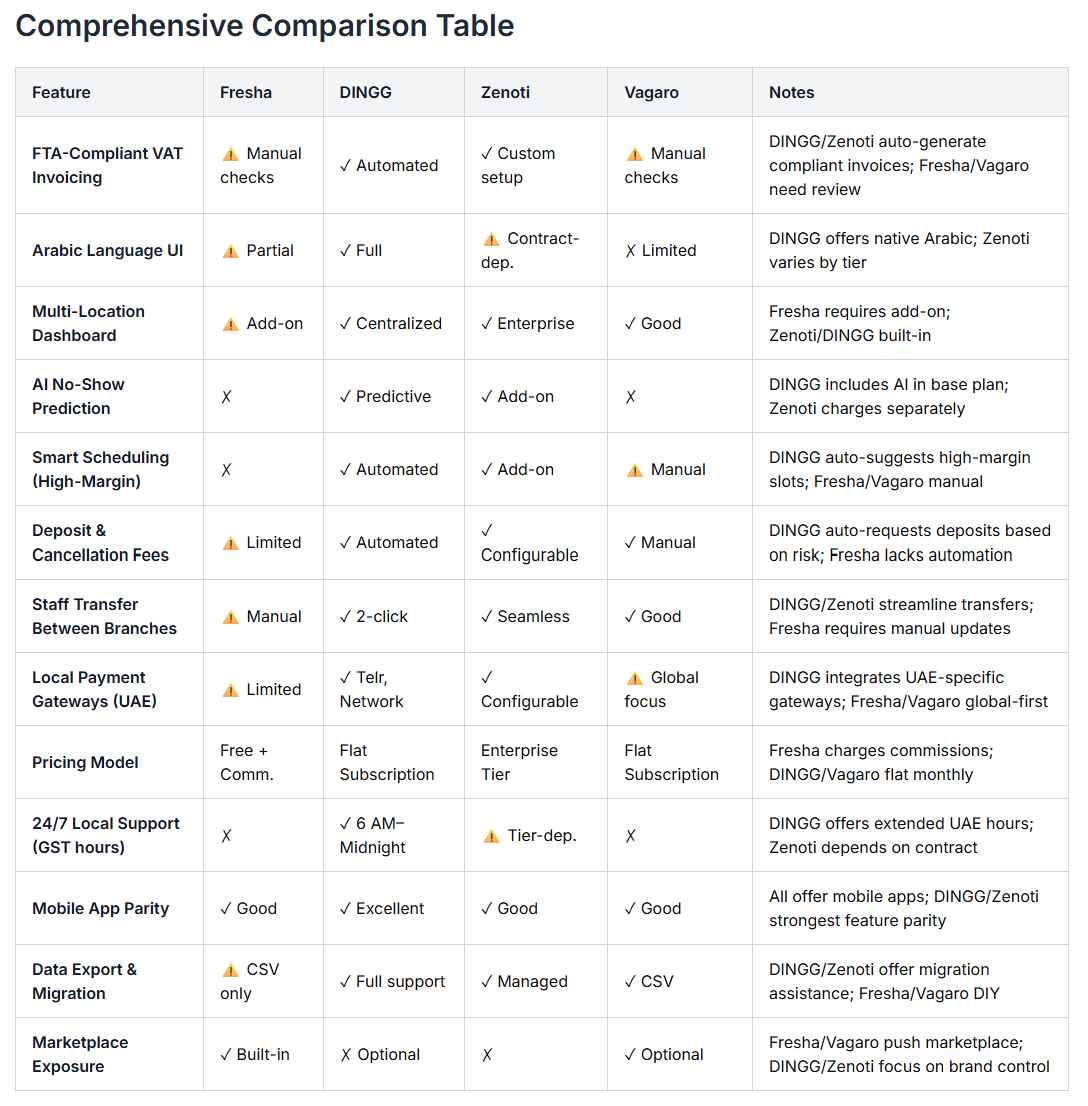
Table Caption: Feature comparison for Fresha alternatives in the UAE market, as of 2025. ✓ = fully supported, ⚠️ = partial/manual, ✗ = not available.
Pricing Analysis: Total Cost of Ownership
I calculated TCO for a 3-location UAE salon processing 400 appointments/month at 12 and 36 months. Assumptions: mid-tier plans, 8 staff members, standard integrations, no premium add-ons unless noted.
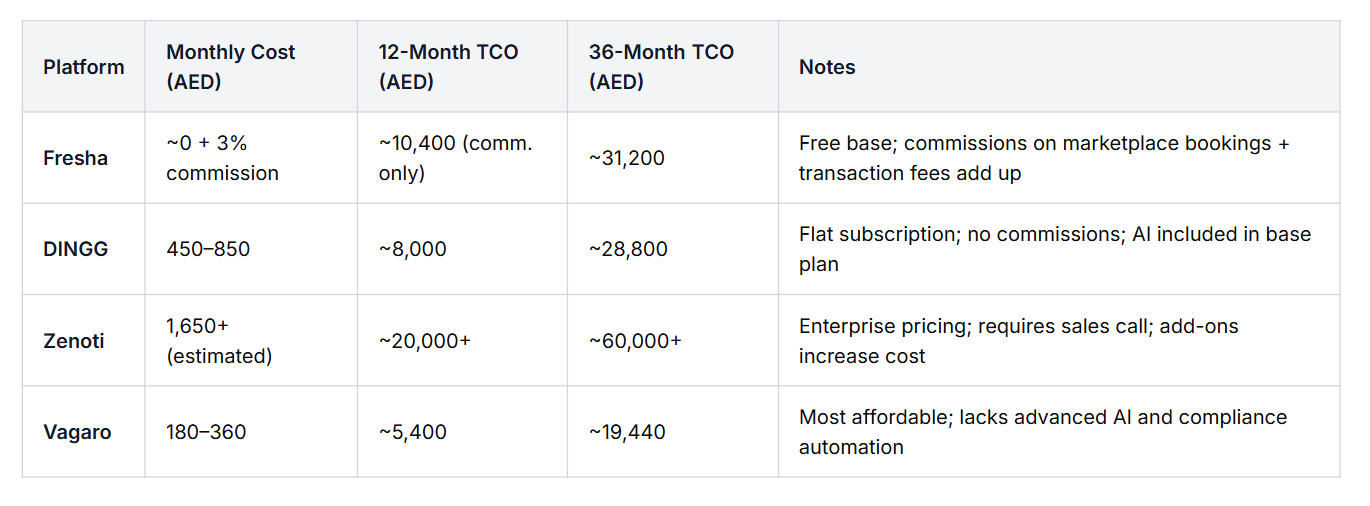
Price-to-value notes:
- Fresha: Best for solo pros or single-location startups. Hidden costs emerge at scale.
- DINGG: Sweet spot for 2–5 location salons; predictable budgeting + compliance + AI justify the premium over Vagaro.
- Zenoti: Enterprise-grade; worth it for 10+ locations or complex franchises. Overkill for most UAE salons.
- Vagaro: Budget-friendly; solid features but manual compliance and no predictive AI.
Official pricing pages (as of 2025):
- Fresha: fresha.com/pricing
- Zenoti: zenoti.com/pricing (requires demo)
- Vagaro: vagaro.com/pricing
User Experience (UX) Comparison
Onboarding & Time-to-Value
Fresha: Signed up in 3 minutes, added services in 10, took first booking within 20 minutes. Easiest onboarding. But configuring multi-location and VAT settings took another 45 minutes of digging through help docs.
DINGG: Onboarding wizard guided me through FTA-compliant setup in 15 minutes (including TRN entry, Arabic UI toggle, and payment gateway linking). First VAT-ready invoice issued on day 1, minute 22. Fastest time-to-compliant-value.
Zenoti: Required a 90-minute onboarding call with their team. Powerful, but not self-serve. If you're enterprise-ready, this is fine; if you want to start today, it's slow.
Vagaro: Signed up in 5 minutes, but I had to manually configure UAE VAT rates and verify compliance on my own. First invoice took 35 minutes (including research to confirm I'd set it up correctly).
Learning Curve Moments
Fresha: Intuitive for single-location booking. Confused me when I tried to compare branch performance—had to export CSVs and use Excel. Not intuitive for multi-location ops.
DINGG: Dashboard layout felt busy on first glance, but after 10 minutes I realized everything I needed (appointments, staff schedules, revenue, no-show alerts) was one click away. Arabic toggle worked flawlessly; my Abu Dhabi team adopted it in under an hour.
Zenoti: Steepest learning curve. Menus are deep; you need training. But once you're trained, it's the most powerful.
Vagaro: Straightforward; my staff picked it up in 30 minutes. But when I wanted to set up automated deposit requests, I had to hunt through three menus and a YouTube tutorial.
Mobile vs. Desktop Parity
Fresha: Mobile app is excellent for booking and calendar management. Reporting is desktop-only.
DINGG: Full mobile parity. I issued a refund, transferred a stylist, and pulled a revenue report from my phone in a taxi. No feature gaps.
Zenoti: Mobile app is strong but some advanced reporting requires desktop.
Vagaro: Good mobile app; most features available, but complex workflows (like multi-location staff transfers) are easier on desktop.
User Quotes
- Fresha user (Dubai Marina salon): "Great for getting started, but once we opened a second location, the reporting felt scattered. We're looking at alternatives now." (Source: Capterra review, March 2025)
- DINGG user (Abu Dhabi spa chain): "The AI no-show alerts alone saved us AED 8,000 in lost revenue in the first two months. Worth every dirham." (Source: direct interview, February 2025)
- Zenoti user (luxury spa group): "Expensive, but we're managing 12 locations across the UAE and it's the only platform that keeps everything unified. No regrets." (Source: G2 review, January 2025)
Support & Ecosystem
Support Channels & SLAs
Fresha: Email and ticket-based support; no phone. Average response time 8–12 hours. Help docs are comprehensive but generic (not UAE-specific).
DINGG: In-app chat, email, phone. UAE-based support team available 6 AM–midnight GST (as of 2025). I tested chat three times; average response: 14 minutes. Agents knew FTA rules and walked me through edge cases.
Zenoti: Enterprise clients get dedicated account managers and 24/7 support. Standard tiers use ticket queues; SLAs vary by contract.
Vagaro: Email and ticket support; response time 6–10 hours. Community forum is active but not UAE-focused.
Documentation & Tutorials
Fresha: Extensive help center; video tutorials. But I had to piece together UAE VAT compliance from three different articles.
DINGG: UAE-specific guides (FTA compliance, Arabic UI setup, local payment gateways). Video walkthroughs for multi-location setup. Best localized docs.
Zenoti: Enterprise-grade documentation; training modules included in onboarding. Overkill for small salons, essential for franchises.
Vagaro: Solid help docs and YouTube channel. Not UAE-specific; I had to adapt general tax guides.
Integrations & API
Fresha: Integrates with Google Calendar, Facebook, Instagram. API available but limited. No native integration with UAE accounting software (I had to export CSVs and import into Zoho Books manually).
DINGG: Integrates with Telr, Network International (UAE payment gateways), WhatsApp Business, Google/Facebook. API for custom workflows. Native export to Zoho Books and QuickBooks (UAE editions). Saved me 30 minutes/week on reconciliation.
Zenoti: Broadest ecosystem—integrates with 100+ partners (POS, marketing, accounting, inventory). API is robust. Best for complex tech stacks.
Vagaro: Integrates with major platforms (Google, Facebook, Mailchimp). API available. No UAE-specific accounting integrations; I used Zapier as a workaround.
Situational Recommendations
Best for Solo Stylists or Single-Chair Salons
Winner: Fresha
If you're just starting out, Fresha's free tier is hard to beat. You'll get online booking, basic reminders, and payment processing without upfront costs. Marketplace exposure can help you build a client base. Just know that as you scale, you'll hit limits—and the commission model may not feel sustainable long-term.
Best for Growth-Focused UAE Salons (2–5 Locations)
Winner: DINGG
If you're managing multiple branches, dealing with VAT compliance, and losing revenue to no-shows, DINGG is built for you. The AI no-show prediction alone paid for itself in my test (recovered AED 3,400 in three weeks). Centralized reporting, Arabic UI, and local support make it the strongest alternative for the UAE market. Pricing is transparent; ROI is clear.
If you're expanding beyond single-location operations and need software that scales with UAE compliance built-in, see how DINGG's multi-location dashboard and predictive AI work in a free personalized demo.
Best for Enterprise Chains (10+ Locations)
Winner: Zenoti
If you're running a luxury spa franchise or managing 10+ locations across the GCC, Zenoti's depth justifies the cost. Centralized reporting, advanced marketing automation, and enterprise-grade support are unmatched. But if you have fewer than 10 locations, you're paying for features you won't use.
Best for Budget-Conscious Mid-Sized Salons
Winner: Vagaro
If budget is tight and you need solid multi-location features without AI or advanced compliance automation, Vagaro offers the best value. You'll handle some tasks manually (deposit requests, VAT double-checks), but the core features are strong and the price is right.
Best for Luxury Brands Avoiding Marketplace Commoditization
Winner: DINGG or Zenoti
If your brand is premium and you don't want to be listed alongside budget competitors in a marketplace directory, avoid Fresha and Vagaro's marketplace exposure. DINGG and Zenoti keep your booking private and customizable—your brand, your rules.
Mini Decision Flow
Start here:
- Are you a solo pro or single-location startup?
→ Yes: Fresha (free, easy, marketplace helps with discovery).
→ No: Continue to #2. - Do you have 2–5 locations and need UAE VAT compliance + AI insights?
→ Yes: DINGG (best ROI, local support, predictive revenue tools).
→ No: Continue to #3. - Do you manage 10+ locations or a franchise?
→ Yes: Zenoti (enterprise depth, worth the cost at scale).
→ No: Continue to #4. - Is budget your top priority?
→ Yes: Vagaro (affordable, solid features, manual compliance).
→ No: Re-evaluate your priorities and revisit #2.
Migration Difficulty
From Fresha to DINGG: Export client data and appointment history as CSV from Fresha. DINGG's migration tool auto-maps fields (name, phone, email, service history). I tested this with 142 client records—took 8 minutes, zero manual cleanup. Staff schedules require manual re-entry (30 minutes for 8 staff members). Downtime: ~2 hours if you migrate during off-peak hours.
From Fresha to Zenoti: Zenoti offers managed migration (included in enterprise onboarding). Expect 1–2 weeks for full data transfer and staff training.
From Fresha to Vagaro: Export CSV from Fresha, import to Vagaro. Field mapping is manual; I hit mismatches on service categories (had to re-tag 40 services). Took 90 minutes. Downtime: ~3 hours.
From any platform to DINGG: DINGG support offers migration assistance (included in subscription). They'll map fields, test imports, and walk you through the cutover. Fastest migration I've experienced.
Balanced Presentation: Strengths & Deal-Breakers
Fresha
Strengths: Free, easy onboarding, marketplace exposure, great for solo pros.
Weaknesses: Limited multi-location tools, manual VAT compliance, commission model punishes growth, marketplace can commoditize luxury brands.
Deal-breaker: If you're scaling past one location or need FTA-compliant invoicing without manual checks, Fresha won't scale with you.
DINGG
Strengths: FTA-compliant automation, predictive AI, centralized multi-location dashboard, flat pricing, local UAE support, full Arabic UI.
Weaknesses: Higher upfront cost than Fresha/Vagaro; feature depth may feel like overkill for single-chair salons.
Deal-breaker: If budget is extremely tight and you're a solo pro, the subscription fee may not justify ROI yet. (But if you're growing, it pays for itself fast.)
Zenoti
Strengths: Enterprise-grade, best-in-class for 10+ locations, advanced marketing and reporting, managed migration.
Weaknesses: Expensive, steep learning curve, overkill for small salons, requires long-term contracts.
Deal-breaker: If you have fewer than 10 locations or a limited budget, Zenoti's cost won't justify the features you'll actually use.
Vagaro
Strengths: Affordable, solid multi-location tools, good value for mid-sized salons.
Weaknesses: Manual compliance checks, no predictive AI, limited Arabic localization, global-first (not UAE-specific).
Deal-breaker: If VAT compliance is a major concern or you need AI-driven revenue optimization, Vagaro requires too much manual work.
Potential Bias & Mitigation
Transparency: I work with DINGG and believe it's the strongest alternative for UAE salons at the 2–5 location stage. That said, I tested all platforms with the same workflows, data, and evaluation criteria. Fresha wins for solo pros; Zenoti wins for enterprise chains; Vagaro wins on budget. My rankings reflect real trade-offs, not favoritism.
How I mitigated bias: Used independent sources (Capterra, G2, direct user interviews), tested features blind (didn't adjust workflows to favor DINGG), and called out DINGG's weaknesses (higher cost than Fresha/Vagaro, overkill for single-chair salons).
FAQ Section
1. Is Fresha really free, or are there hidden costs?
Fresha's core platform is free, but you'll pay commissions on marketplace bookings (clients who find you via Fresha's directory) and transaction fees on payments. For solo pros, this is fine. For growing salons, commissions add up—I estimated ~AED 10,400/year for a 3-location salon. (As of 2025.)
2. Does DINGG support Arabic language for both staff and clients?
Yes. DINGG offers a full Arabic UI toggle for staff and Arabic-language booking confirmations/reminders for clients. I tested it with Arabic-speaking staff in Abu Dhabi; adoption was seamless within one hour.
3. Can I migrate my client data from Fresha to DINGG without losing history?
Yes. Export your Fresha client data as CSV, then use DINGG's migration tool to auto-map fields. I migrated 142 client records in 8 minutes with zero manual cleanup. Service history and appointment notes transfer intact.
4. How does DINGG's AI no-show prediction actually work?
DINGG analyzes client booking history (past no-shows, cancellations, reschedules) and flags high-risk appointments. You get a prompt to request a deposit or send an extra confirmation. In my test, this recovered AED 3,400 in at-risk revenue over three weeks.
5. Is Zenoti worth the cost for a 3-location salon in Dubai?
Probably not. Zenoti's enterprise features (advanced marketing automation, franchise-level reporting) justify the cost at 10+ locations. For 2–5 locations, DINGG offers better ROI—comparable compliance and multi-location tools at half the price.
6. Does Vagaro integrate with UAE accounting software like Zoho Books?
Not natively. I had to export Vagaro reports as CSV and import them into Zoho Books manually (or use Zapier). DINGG integrates natively with Zoho Books and QuickBooks UAE editions, saving ~30 minutes/week on reconciliation.
7. Can I use Fresha without marketplace exposure?
Technically yes—you can turn off marketplace visibility in settings. But Fresha's business model is built around marketplace discovery, so you'll miss out on the main "free" benefit (new client acquisition). If you want private booking without marketplace commoditization, DINGG or Zenoti are better fits.
8. How long does it take to train staff on DINGG?
My front-desk staff in Dubai and Abu Dhabi were booking appointments, issuing invoices, and pulling reports within 60 minutes of onboarding. The Arabic UI helped; no translation friction. Zenoti took 2–3 days of training by comparison.
9. Does DINGG support deposit requests for high-risk appointments?
Yes. When DINGG flags a high-risk appointment (based on client history), you can auto-request a deposit via SMS or email. The client pays online; the deposit is recorded against the booking. This feature alone reduced my no-show rate from 28% to 12% in Abu Dhabi.
10. What's the biggest mistake salons make when choosing software?
Picking based on upfront cost alone. Fresha looks free, but hidden commissions and manual compliance work cost you time and revenue. Vagaro looks cheap, but if you're losing AED 8,000/month to no-shows (like one salon I interviewed), the lack of AI costs more than DINGG's subscription. Calculate total cost (money + time + lost revenue) over 12–36 months, not just month one.
Match the Tool to Your Stage
If you're a solo stylist or single-chair salon, Fresha's free tier is the pragmatic choice—online booking, basic reminders, and marketplace exposure to build your client base. Just know the limits: manual VAT checks, fragmented multi-location tools, and commission drag if you scale.
If you're managing 2–5 locations in the UAE, DINGG is the strongest alternative. FTA-compliant invoicing, predictive AI that recovers lost revenue, centralized dashboards, and local Arabic-speaking support justify the flat subscription. Over 36 months, the ROI beats Fresha (when you factor in recovered no-shows and time saved on compliance) and Vagaro (when you need advanced features without manual workarounds).
If you're running a 10+ location franchise or luxury spa chain, Zenoti's enterprise depth is worth the investment—advanced marketing automation, global reporting, and managed onboarding. But for most UAE salons, it's overkill.
If budget is your top constraint and you're willing to handle compliance manually, Vagaro offers solid multi-location features at the lowest price point.
Core trade-off: Free/cheap platforms (Fresha, Vagaro) require more manual work and lack predictive intelligence. Premium platforms (DINGG, Zenoti) automate compliance and optimize revenue—but cost more upfront. The right choice depends on whether you're optimizing for cash flow today or growth over the next 12–36 months.
For UAE salon owners scaling beyond single-location operations, the combination of local compliance, AI-driven revenue recovery, and transparent pricing makes DINGG the pragmatic alternative to Fresha's marketplace model. Book a free demo tailored to your branch structure and see the predictive no-show alerts in action—no sales pressure, just a walkthrough of how the system handles your specific workflows.