A salon owner in Bengaluru once told me her biggest mystery wasn't finding new clients. It was keeping them.
"They come once, love it, say they'll be back — and then I never see them again," she said. She had a full appointment book on weekends and half-empty slots by Wednesday. Great first impressions. Zero second visits.
Sound familiar?
Here's the hard truth most salon owners don't want to hear: acquiring a new client costs 5× more than retaining an existing one. And yet, most salons spend all their energy on walk-ins, Instagram ads, and first-time offers — while their most valuable asset, their existing client base, quietly drifts away.
The salons that crack repeat business in 2026 aren't doing it with better haircuts alone. They're doing it with smarter systems — software that remembers clients, rewards loyalty, personalises communication, and turns a one-time visit into a long-term relationship.
Here's your promise: By the end of this guide, you'll know exactly how salon software — specifically DINGG — turns first-time clients into regulars, and regulars into your most profitable growth engine.
Before You Start: Are You Losing Repeat Clients Without Realising It?
Run this quick check before reading further.
Answer yes or no:
Do you know how many clients visited you last month but haven't rebooked yet?
Can you tell, in under 60 seconds, which clients haven't been in for 60+ days?
Do your clients receive a personalised follow-up after every visit — automatically?
Does your loyalty programme update without anyone on your team doing it manually?
If you answered no to two or more: You're losing repeat clients to friction, not to bad service. The good news — every single one of these is fixable with the right salon software. Keep reading.
If you answered yes to all four: Skip to Phase 3. You're operationally ready but likely leaving retention revenue on the table through untapped marketing and membership tools.
Why Repeat Clients Are Your Salon's Real Business Model
Before the tactics, the context.
The average Indian salon sees roughly 65–70% of its monthly revenue come from repeat clients. Not new footfall. Not walk-ins. Clients who came before and chose to come back. For multi-location salons, that number climbs even higher — loyal clients across branches are the backbone of sustainable revenue.
Yet the average rebooking rate at salons without dedicated retention systems sits at just 32%. That means 68 out of every 100 clients who walk through your door once — never return.
With the right salon management software, that 32% can realistically climb to 55–60% within six months. That's not a marginal improvement. For a salon doing ₹3 lakh a month, closing even half that gap means ₹50,000–₹70,000 in additional monthly revenue — from clients you already have.
Here's how it works, phase by phase.
Phase 1: Make It Effortless to Come Back
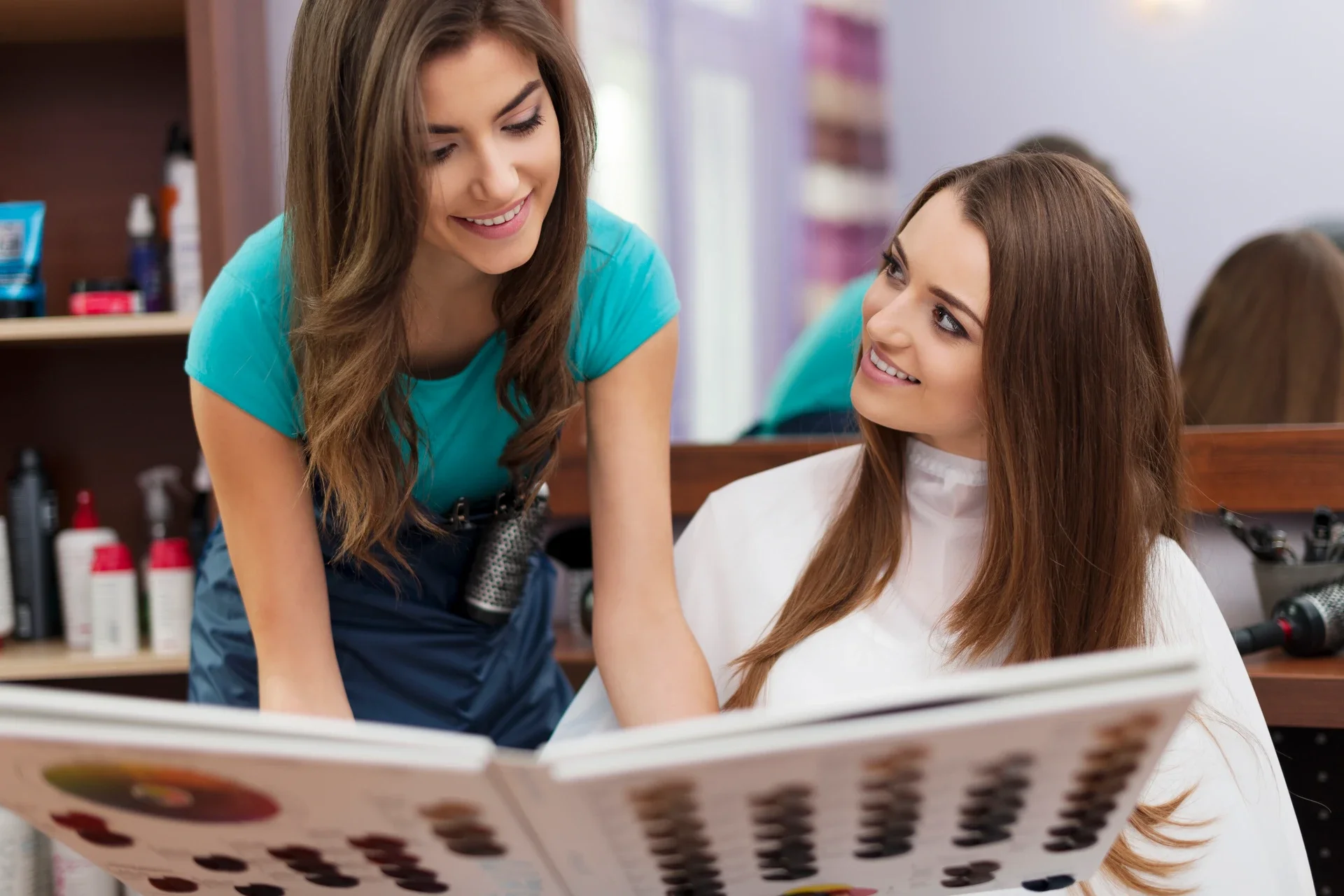
The first repeat visit is the hardest one to earn. Most clients don't rebook because nobody asked them to — not at checkout, not the next day, not ever.
24/7 Online Booking
The single fastest way to increase rebooking rates is removing the friction from the rebooking itself. 24/7 Online Booking means a client can rebook at 10 PM on a Sunday from their couch — the exact moment they think "I should get my roots done again."
If they have to call during business hours, they'll forget. If they have to DM and wait for a reply, they'll lose momentum. If there's a link in your WhatsApp message that takes them directly to your booking page — they'll book. Right then.
What to do:
Place your online booking link in every post-visit WhatsApp message, your Instagram bio, and your Google Business Profile.
Set up a rebooking prompt in your confirmation message — "Loved your visit? Book your next appointment now" with a direct link.
Make sure your booking flow shows real-time slot availability. Clients abandon flows that require a callback to confirm — you lose them in that gap every time.
Visual checkpoint: Send yourself a test booking right now. From the first tap to the confirmation message, it should take under 60 seconds and require zero phone calls. If it doesn't — fix the flow before you invest in any other retention tool.
Smart Scheduling
Smart Scheduling does more for repeat business than most owners realise. When clients are automatically assigned to the same stylist they saw last time — based on preference logged in their profile — they feel known. That familiarity is one of the strongest drivers of rebooking behaviour in the beauty industry.
What to do:
Enable stylist preference tagging in your scheduling system. When a client books online, the system should offer their last stylist as the default option.
Use drag-and-drop calendar management to block efficient time slots — back-to-back appointments reduce wait times and improve the experience that drives the decision to return.
Set buffer times accurately. A client who waits 20 minutes past their slot because the previous appointment ran over is a client who thinks twice before rebooking.
Verification test: Check your last 30 appointments. What percentage of returning clients were assigned to the same stylist as their previous visit? If it's below 60%, your scheduling isn't supporting relationship continuity.
Phase 2: Make Every Client Feel Known
This is where good salons separate from great ones. The difference between a client who feels like a regular and one who feels like a stranger is almost entirely about information — whether your team knows who they are, what they like, and what they need.
Personalized Profiles
Personalized Profiles are the memory your team can't have on their own. Every client preference, service history, product sensitivity, birthday, and visit note — stored, searchable, and visible at checkout.
What to do:
At every first visit, capture: preferred stylist, services interested in, any scalp or skin sensitivities, and whether they prefer WhatsApp or SMS for reminders.
After every appointment, log a brief service note. "Used Wella Koleston 6.0, client preferred low-ammonia option" is the difference between a client who feels remembered and one who has to explain their hair history every single visit.
Use the birthday field. An automated "Happy Birthday — enjoy 20% off this month" message costs nothing to set up and consistently outperforms any paid acquisition campaign.
Visual checkpoint: Open any returning client's profile. You should see their last three services, the products used, their preferred stylist, and any notes from previous visits. If the profile is blank — start filling it today. Every empty profile is a missed retention opportunity.
Client Feedback
Client Feedback is not just a satisfaction metric — it's a retention tool. Clients who receive a follow-up survey feel valued. Clients who see their feedback acted on become loyal advocates.
What to do:
Trigger an automated 3-question survey 24 hours after every visit — not immediately at checkout when clients are rushing out. Timing matters.
Keep surveys short: overall experience rating, likelihood to rebook, one open text field. That's it.
Flag any response below 4 stars for a personal follow-up within 48 hours. A dissatisfied client who receives a genuine "we'd like to make this right" call books again at a higher rate than a satisfied client who never heard from you.
The number worth knowing: Salons with active post-visit feedback systems see 18% higher 90-day rebooking rates than those without. Clients who feel heard come back.
Forms & Surveys
Forms & Surveys go beyond post-visit feedback. They're the tool for collecting consent forms before chemical treatments, gathering skin consultation data before facials, and running quarterly preference surveys that keep your service menu aligned with what clients actually want.
What to do:
Create a digital intake form for first-time clients — sent via WhatsApp before their appointment. Clients who invest 2 minutes filling out a form before they arrive are more committed to showing up and more likely to rebook.
Run a bi-annual "What would you like to see at our salon?" survey to your existing client base. The responses give you a service development roadmap — and clients who were consulted feel ownership over the result.
DINGG's Personalized Profiles, Client Feedback, and Forms & Surveys work together as one connected retention system — every data point captured makes the next interaction more personal and more valuable. See how DINGG builds client relationships
Phase 3: Build Financial Reasons to Return
Emotional connection brings clients back. Financial incentive accelerates the timeline and increases visit frequency. The most effective retention programmes do both.
Loyalty Rewards
Loyalty Rewards are the most direct tool in your retention stack — and the most under-utilised. The average Indian salon with a loyalty programme sees enrolled clients visit 2.1× more frequently than non-enrolled clients. That's not a small edge. That's a structural revenue advantage.
What to do:
Set up automatic point accrual per visit and per rupee spent. The key word is automatic — if staff have to manually update a card or ledger, it won't happen consistently, and inconsistency kills programme trust.
Create milestone rewards that go beyond "10th visit free." Think behaviour-based triggers: first skincare booking, first referral, 6-month anniversary. These feel personal rather than transactional.
Make points visible. Send a WhatsApp update after every visit: "You earned 60 points today. Your balance is 240 — just 60 more for a free hair spa." That message does more for rebooking than any discount flyer.
Visual checkpoint: Open your loyalty dashboard. It should show total active members, average points balance, and monthly redemption rate. If redemption is below 20% — your rewards aren't attractive enough, or clients don't know the programme exists. Fix communication first.
Membership Programs
Membership Programs are the closest thing salons have to predictable, recurring revenue. A client on a ₹1,500/month membership who gets unlimited blowouts and 20% off colour treatments isn't just a regular — they're a committed revenue stream.
What to do:
Design two or three membership tiers based on your most popular service combinations. Don't offer ten tiers — choice overload kills conversion.
Add a priority booking benefit to every membership tier. The ability to book the best slots before non-members is worth more to busy clients than almost any discount.
Use Customer Segmentation to identify your top 20% by visit frequency — these are your membership candidates. Launch with a personal invite rather than a mass blast. Conversion rates on personal invites are 3–4× higher.
Gift Cards
Gift Cards are consistently underused by Indian salons and consistently overperforming in the data. A happy client buying a ₹2,000 gift card for a friend is doing three things simultaneously: prepaying for a future visit, referring a new client, and endorsing your salon with their personal credibility.
What to do:
Make gift cards available digitally — shareable via WhatsApp in seconds. A card that requires the buyer to visit your salon to purchase it defeats the purpose.
Create occasion-specific gift card designs: Diwali, Raksha Bandhan, Mother's Day, birthdays. Occasion framing drives impulse gifting.
Track redemption in your reporting dashboard. A gift card redemption is your introduction to a new potential regular — treat that first visit with extra attention.
Phase 4: Market Smarter, Not Louder
Most salon marketing reaches everyone and converts no one. The shift from broadcast to targeted communication is where retention marketing becomes genuinely powerful.
Targeted Marketing
Targeted Marketing via WhatsApp, SMS, and email works when the message is relevant. Sending a "monsoon hair care package" offer to a client whose last visit was a keratin treatment 8 weeks ago is relevant. Sending the same offer to every client in your database regardless of their history is noise.
What to do:
Build campaigns around service history, not just calendar timing. A client who books colour every 6–8 weeks is overdue at week 9 — that's exactly when to send the nudge.
Set up automated win-back campaigns for lapsed clients — those who haven't visited in 60+ days. A simple "We miss you — here's 15% off your next visit, valid for 2 weeks" sent at the 60-day mark consistently recovers 12–18% of lapsed clients.
Never send a promotional message without a direct booking link. Every extra tap between the message and the appointment is a dropout point.
Customer Segmentation
Customer Segmentation is the engine behind every targeted campaign. Without segmentation, you're guessing. With it, you're operating on data.
What to do:
Set up four core segments at minimum: New Clients (first visit in the last 30 days), Active Regulars (visited in the last 45 days), At-Risk (no visit in 45–75 days), and Lapsed (no visit in 75+ days). Each segment needs a different message with a different objective.
Use high-spender segmentation to identify clients who are worth a personal phone call — not just an automated WhatsApp. Clients in your top 10% by lifetime spend respond exceptionally well to a personal check-in.
Rebuild your segment list monthly. A client moves from Active to At-Risk in 30 days of inactivity. Your campaigns need to reflect current status, not last month's data.
DINGG's Targeted Marketing and Customer Segmentation tools let you build and fire precise campaigns in minutes — with automated triggers that run in the background while you focus on clients in your chair. Explore DINGG's marketing features
Phase 5: Run the Operation That Makes Retention Possible
Retention isn't just a marketing problem. It's an operational one. Clients don't return to salons that kept them waiting, ran out of their preferred product, or charged them incorrectly. The backend has to be clean for the front-end experience to deliver on its promise.
Real-Time Reports
Real-Time Reports tell you where retention is breaking down before it becomes a trend. A sudden drop in 30-day rebooking rate from one stylist is a signal worth catching early — not at the end of the quarter.
What to do:
Check your rebooking rate by stylist weekly. A stylist with a 70% rebooking rate and one with a 30% rate need different conversations — but you can only have those conversations if you have the data.
Monitor your new-to-returning client ratio monthly. If new clients are growing but returning clients are flat, you have a retention leak. If returning clients are growing but new clients are flat, you have an acquisition gap.
Track revenue per client per visit over time. A declining average ticket value from your regulars is often the first signal that your upsell process has stalled.
Staff Management
Staff Management directly impacts repeat business because client retention is, in large part, stylist retention. Clients who lose their preferred stylist — to another branch, to a schedule change, or to poor communication — are statistically more likely to try a competitor.
What to do:
Track client-to-stylist retention rates. Which of your staff members have the most loyal personal following? Protect their schedules, involve them in retention initiatives, and use their client data to inform your overall programme.
Use accurate commission tracking to align staff incentives with retention goals. A commission structure that rewards only new bookings inadvertently penalises the stylist who keeps the same 40 clients happy for three years.
Monitor attendance and lateness patterns. A stylist who runs habitually late creates the worst kind of first impression on a rebooked client: one that makes them second-guess coming back.
Inventory Control
Inventory Control sounds like a back-office problem. It isn't. "Sorry, we're out of the product we used on your hair last time" is one of the most reliable ways to break the momentum of a returning client relationship.
What to do:
Set automated reorder alerts for every product used in your top five services. Never discover you're out mid-appointment.
Track product consumption by service and by stylist. This tells you your actual cost per treatment — and reveals whether your pricing is protecting your margins.
Sync inventory data with your Easy Invoices system so product usage is accurately reflected in client bills. Accurate billing builds trust; billing surprises destroy it.
Easy Invoices
Easy Invoices with clean, itemised billing aren't just an accounting tool — they're a client experience touchpoint. A professional GST-compliant invoice sent via WhatsApp after a visit signals that your salon is organised, trustworthy, and serious about its clients.
What to do:
Automate invoice generation at checkout — no manual calculation, no handwritten slips.
Include a rebooking prompt in the invoice message: "Thank you for your visit! Ready to book your next appointment?" followed by your direct booking link.
Use monthly invoice data to flag clients whose spend has been declining — an early warning sign of churn before they disappear entirely.
Multi-Location Support
For salon owners running two or more branches, Multi-Location Support is the retention tool that nobody talks about enough. A client who moves neighbourhoods and finds your second branch should feel like a seamless extension of the relationship — same preferences, same history, same loyalty points balance.
What to do:
Maintain one unified client database across all locations. A client profile from your Andheri branch should be fully visible to your Bandra branch — instantly.
Ensure loyalty points are redeemable at any location. Points that are branch-locked create frustration for your most mobile clients — often your highest spenders.
Run cross-location performance reports monthly. If one branch has a significantly lower rebooking rate, that's a branch-specific problem worth diagnosing — staffing, scheduling, client experience — before it becomes a revenue problem.
DINGG AI Genius
DINGG AI Genius brings all of these tools together under one AI-powered layer that operates while you sleep. It's the difference between a system you have to manage and a system that manages itself.
AI Genius analyses booking patterns and proactively surfaces clients who are at risk of lapsing — before the 60-day window. It identifies the optimal time to send a re-engagement message for each individual client based on their historical behaviour. It personalises communication at scale — so a campaign that goes to 300 clients doesn't read like a mass blast, but like a message written specifically for each person.
For Indian salon owners, this means running retention intelligence that would otherwise require a dedicated marketing manager — from a phone, at the cost of a subscription.
DINGG AI Genius, combined with Smart Scheduling, Personalized Profiles, Loyalty Rewards, and Targeted Marketing, gives your salon a complete retention engine — not a collection of disconnected features. Book a free demo and see DINGG in action
The Honest Challenges: What Nobody Warns You About Retention
ChallengeWhat Actually HappensThe Fix
Loyalty programme isn't mentioned at checkout
Clients don't know their points balance, so the programme doesn't influence rebooking
Add a 15-second loyalty update to every checkout script — make it a non-negotiable step
Segmentation data goes stale
Campaigns based on 90-day-old segment data reach clients in the wrong lifecycle stage
Rebuild segments monthly — automate this in DINGG so it happens without a manual trigger
Gift cards are purchased but never redeemed
Unredeemed cards represent blocked revenue and missed client relationships
Set an automated WhatsApp reminder at 3 months post-purchase: "Your gift card is waiting — book now before it expires"
Staff resist client profiling
Service notes are skipped, profiles stay empty, personalisation fails
Tie profile completion to performance reviews — make it a professional standard, not an optional extra
Multi-branch clients feel like strangers at new locations
Receptionist can't see history, client has to re-explain preferences, trust breaks
Enforce single unified database across all branches — no branch-specific client records
FAQs
How quickly can salon software improve my repeat customer rate?
With 24/7 Online Booking and automated rebooking prompts active, most salons see a measurable improvement in 30-day rebooking rates within the first 4–6 weeks. Loyalty and membership-driven retention gains compound over 3–6 months as the client base gets enrolled and engaged.
Which DINGG feature has the biggest direct impact on repeat bookings?
In isolation, Personalized Profiles combined with Targeted Marketing delivers the strongest direct impact on rebooking rates — because the combination ensures the right client gets the right message at the right time. But the real power is in how DINGG's features work together as one system rather than separate tools.
Is a loyalty programme worth setting up for a small single-location salon?
Yes — without question. Enrolled loyalty members visit 2.1× more frequently than non-enrolled clients regardless of salon size. The setup time with DINGG's Loyalty Rewards is under a day. The ROI starts showing in the first month.
How do I use Customer Segmentation to recover lapsed clients?
Filter your client database for anyone with no visit in the last 60–75 days. Create a targeted WhatsApp campaign with a time-limited offer — "We miss you, here's 15% off valid for 2 weeks." Add a direct booking link. DINGG's Customer Segmentation makes this a 10-minute exercise, not a half-day project.
Can DINGG help me manage repeat clients across multiple salon branches?
Absolutely. DINGG's Multi-Location Support maintains a unified client database, loyalty points, and booking history across every branch. A client who moves from your Pune branch to your Mumbai branch carries their full relationship with them — no awkward reintroductions, no lost history.
How does DINGG AI Genius help with client retention specifically?
DINGG AI Genius monitors individual booking patterns and predicts churn risk before it happens. It surfaces at-risk clients, identifies the optimal outreach timing for each person, and personalises campaign messaging at scale — so your retention system runs proactively, not reactively.
That Bengaluru salon owner I mentioned at the start? She spent six months trying to solve her repeat client problem with better service and more Instagram content. Neither moved the needle.
Then she switched to a system that remembered her clients for her, rewarded them automatically, and reached out at exactly the right moment. Her 90-day rebooking rate went from 28% to 54% in under four months.
Her words: "I didn't change what I do in the chair. I changed what happens after they leave."
That's what salon software does when it's built for retention — not just bookings.
Ready to turn your existing clients into your most reliable growth engine? DINGG brings DINGG AI Genius, Personalized Profiles, Loyalty Rewards, Targeted Marketing, Smart Scheduling, and every tool in this guide into one platform — built specifically for salons that want to grow through retention.