Is Google's AI Recommending Your Spa? How to Get Cited
Author
KOELIDate Published
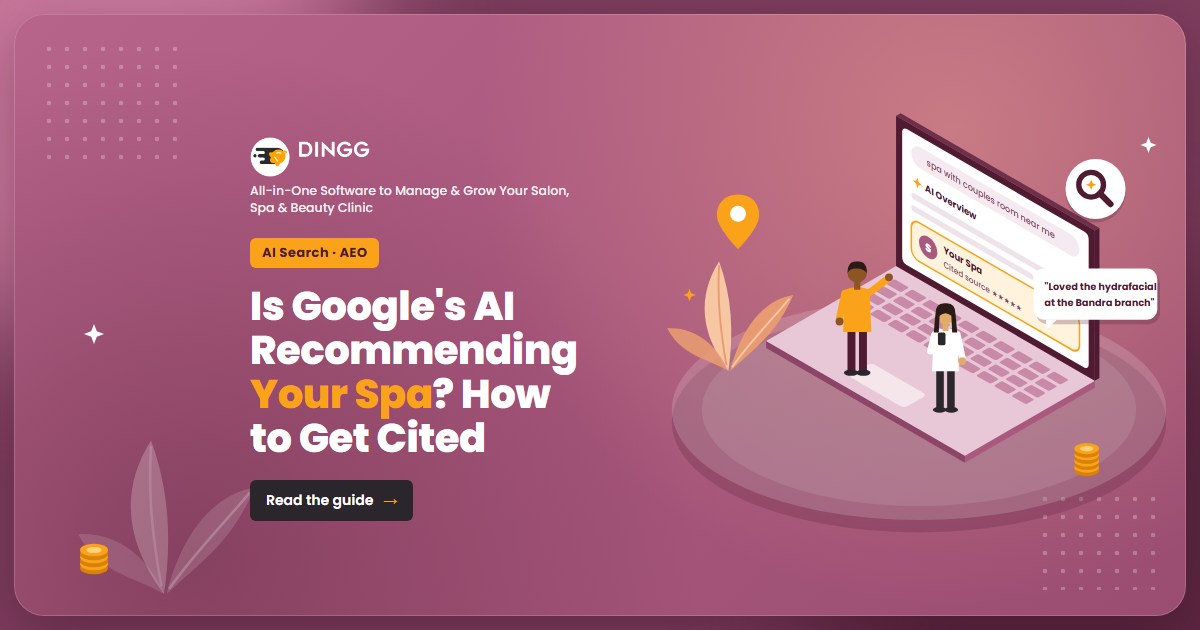
Picture a guest in Bandra typing "which spa near Linking Road has a private couples room with a Jacuzzi" into Google. She never scrolls past the AI summary. Your spa has that room and a wall of five-star reviews. The AI Overview cites a competitor and a Reddit thread instead. She taps, she books, she's gone.
That click didn't go to a blue link or to Maps. It went to whichever source the AI judged most useful for a very specific research question. Your spa wasn't in the running.
The short answer: AI search for spas rewards the business that is easiest to quote. Google's AI Overviews, ChatGPT and Gemini cite spas whose Business Profile, reviews and website all answer specific questions (services, prices, rooms, neighbourhood) clearly and consistently. Get those three right, keep a 24/7 booking link behind them, and re-check monthly.
Below are six steps to audit, fix and monitor your visibility, and to make sure the guest who finds you can book on the spot.
How AI search for spas actually works (and where the click goes)
AI Overviews haven't replaced the "spa near me" map pack. They sit on top of the research that happens before someone is ready to book: comparisons, service-specific questions, neighbourhood recommendations.
Seer Interactive's April 2026 analysis of 5.47 million queries found AI Overviews on 95.4% of comparison queries and 85.9% of question-style queries, but on only 8% of commercial and 5% of transactional ones. Your Google Business Profile still drives walk-ins. AI citations now shape the discovery moment that comes before them.
The cost of being left out is real. When a Google AI summary appeared, users clicked a regular result on 8% of visits versus 15% without one, and clicked a source inside the summary on just 1% (Pew Research Center, July 2025, browsing data from 900 US adults). But being the cited source changes the maths: brands cited inside an AI Overview earned about 120% more organic clicks per impression than brands that weren't (Seer Interactive, 2026).
The Ugly Truth
You have 200+ reviews but the AI cites a competitor with 40 — Fix: Ask every guest for a review that names the treatment and branch · Why it happens: Specific, recent review text gives AI something to quote; "Great experience!" doesn't
Your website is indexed but never cited — Fix: Put service names, prices and answers in the first screen of the page · Why it happens: AI pulls concise, front-loaded answers, not brand stories under a hero image
Reddit or YouTube shows up instead of your site — Fix: Earn mentions on third-party sites too, and answer the same questions on your own page · Why it happens: AI treats independent discussion as social proof for subjective questions
One branch appears, the other doesn't — Fix: Audit each branch profile separately · Why it happens: The flagship got updated; the second branch still shows old hours and no services
Before you start: what you need
Four things. Owner or manager access to your Google Business Profile. A website (even a single booking page) whose content you control. Google Search Console for that site. And a phone or browser where you can run prompts in ChatGPT, Gemini and Google AI Mode.
If your spa management software gives you a hosted booking page with its own URL, check it in Search Console. These pages can pull real search visibility on their own: in DINGG's Search Console data, one spa's DINGG-hosted booking page collected 7,570 Google impressions in 90 days, mostly for the spa's own name.
Step 1: Audit what AI says about your spa right now
Open ChatGPT, Gemini and Google AI Mode in separate tabs. Run these prompts with your own city, neighbourhood and services:
"Best [your signature service] in [neighbourhood]"
"Is [your spa name] good for [service]?"
"[Your spa name] vs [competitor name]"
"Which spa in [city] has [specific amenity or treatment]?"
"Top-rated spa near [landmark]"
Screenshot every answer. Note which sources each one cites: your website, your Business Profile, a directory, Reddit, YouTube or nothing.
Visual checkpoint: a folder of 15 or so screenshots across three AI tools, each labelled with the date and prompt.
Don't just test your brand name. Non-branded, service-specific prompts ("best deep tissue massage in JLT", "couples spa with private room in Koramangala") often return completely different sources, and that's where new guests find you.
Step 2: Complete your Google Business Profile like a branch landing page
Open your profile from Google Search or Maps. Go service by service: each one needs a name, a price (a "from" price is fine) and a duration. Set the right primary category (Day Spa, Medical Spa, Massage Spa) plus at least one secondary category. Upload real photos of your treatment rooms, not stock images. Point the booking button at a URL that works at 11 pm on a Sunday.
Running more than one branch? Open each profile separately. It's common for one branch to list twelve services and current hours while the other still shows old timings and nothing else.
Visual checkpoint: every branch shows the right category, current hours, a full priced service list, real photos and a working booking button.
For attributes, Q&A and photo strategy, see our walkthrough on using your Google Business Profile to drive more walk-ins.
Step 3: Get reviews that name treatments and neighbourhoods
"Great experience, will come again!" gives an AI nothing to match. "The 90-minute deep tissue massage at the Bandra branch fixed my desk-job shoulders" gives it a specific, quotable answer.
You can't script reviews, but you can ask at the right moment. Set up automated review requests that go out after every completed appointment and mention the treatment by name ("How was your Hydrafacial today?"). That gives the guest a natural prompt to write something specific. If your spa management software can send the request automatically at checkout, it happens every time, not only on quiet days.
Visual checkpoint: within a month, your newest reviews should start mentioning treatments, branches or neighbourhoods.
Recency matters too. A steady flow of fresh, specific reviews does more than a large pile of old, generic ones.
Step 4: Publish a plain-language treatment menu and FAQ page
AI tools cite pages that answer the question fast. A page called "Our Philosophy" with three paragraphs of brand story will lose to one that opens with "Swedish Massage · 60 min · ₹2,500 · long strokes and kneading for full-body tension" (prices here are illustrative).
Create one page per major service category, or one full menu page if your site is small. Use exactly the same service names as your Business Profile. Add an FAQ underneath with the questions guests actually ask: "Do I need to arrive early?" "Is the couples room private?" "Can I combine a facial and a massage?"
Put the key details in the first 150 words and keep headings literal, not clever.
Visual checkpoint: service names and prices are visible without scrolling, and the FAQ answers real questions.
This is one more reason spa management software is important, even for discovery. When service names and prices come from one system, your booking page, website and profile stop contradicting each other, and contradictions are exactly what make an AI hesitate to cite you.
Step 5: Make the booking link work around the clock
Getting cited is only useful if the visitor can book. If the AI links to your site and it says "Call us to book" at 10 pm, that guest is gone.
Connect one online booking link to your Business Profile button and to every service page. Then test it yourself, on a phone, at an odd hour, all the way to the confirmation screen.
Remember the Pew numbers: very few people click through from an AI answer. The few who do are high-intent. Don't send them to a dead end.
Step 6: Re-check monthly and log what changed
Set a calendar reminder. Re-run the Step 1 prompts, compare screenshots, and note whether you appeared, which page was cited, and what competitors did.
Track branded and non-branded prompts per branch. Showing up for "best spa in Dubai Marina" doesn't mean you show up for "relaxing facial near JLT".
For how Google's AI Mode is changing booking behaviour, read our breakdown of Google AI Mode and salon bookings.
Where this won't help much
If your spa is in a small town with little comparison or question-style searching, AI Overviews may rarely appear for your category. Remember, they show up on only 5% of transactional queries (Seer Interactive, 2026). Your time is better spent on the map pack, referrals and local partnerships. This playbook is for competitive city markets where guests research before they book.
FAQs
Does ChatGPT use Google reviews to recommend spas?
Not directly. ChatGPT and similar tools draw on web pages they can find and read, so reviews, directory listings and your own site all feed what they say. The practical move is the same everywhere: keep reviews fresh and specific across the platforms guests use, and make your own service pages easy to quote.
Do I need a website, or is a Google Business Profile enough?
A profile alone limits what AI tools can cite. They lean on web pages with clear, extractable answers. Even one well-built page with services, prices, an FAQ and a booking link gives them something to reference that a profile listing can't. If your booking platform hosts a public page for you, make sure it's indexed.
How long until AI starts mentioning my spa?
There's no fixed timeline. It depends on how competitive your area is, how complete and consistent your information is, how fresh your reviews are, and how quickly your pages get indexed. That's why the monthly re-check matters: it replaces guessing with a dated record of what changed after each fix you made.
Is SEO dead now that AI answers the question?
No. AI answers are built from the same things good local SEO already demands: an accurate profile, a steady flow of reviews, useful pages and a booking link that works. Most transactional searches still show normal results and the map pack. Treat AI citations as a new layer on top of SEO, not a replacement for it.
Being found is only half the job. The other half is turning that visit into a confirmed booking, even at 11 pm. If you're comparing spa, salon and beauty clinic management software that brings online booking, review requests and client follow-ups into one place, book a free DINGG demo. Our team will walk you through DINGG live and answer your questions, so you can judge the fit for your business yourself.