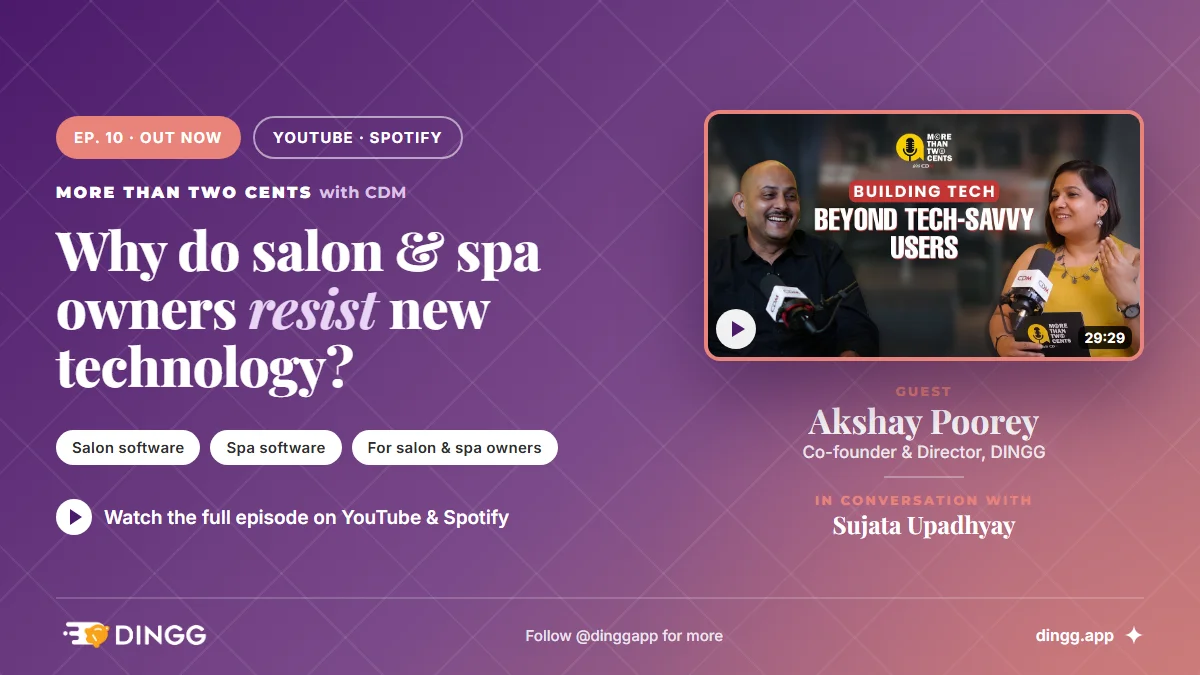
DINGG co-founder Akshay Poorey on More Than Two Cents with CDM: salon software vs Excel, and the four questions that change a salon or spa owner's mind.
Quick answer: If you can't answer four questions from memory (your client retention rate, how many clients you lost last month, which service is your hero service, and what each regular had last time), your Excel sheet has stopped working for you. Salon software tracks all four automatically, every day.
Almost every salon and spa owner I meet says some version of the same thing: "Everything is working fine. We have a diary at the front desk, WhatsApp for bookings and an Excel sheet for the rest. We don't need software."
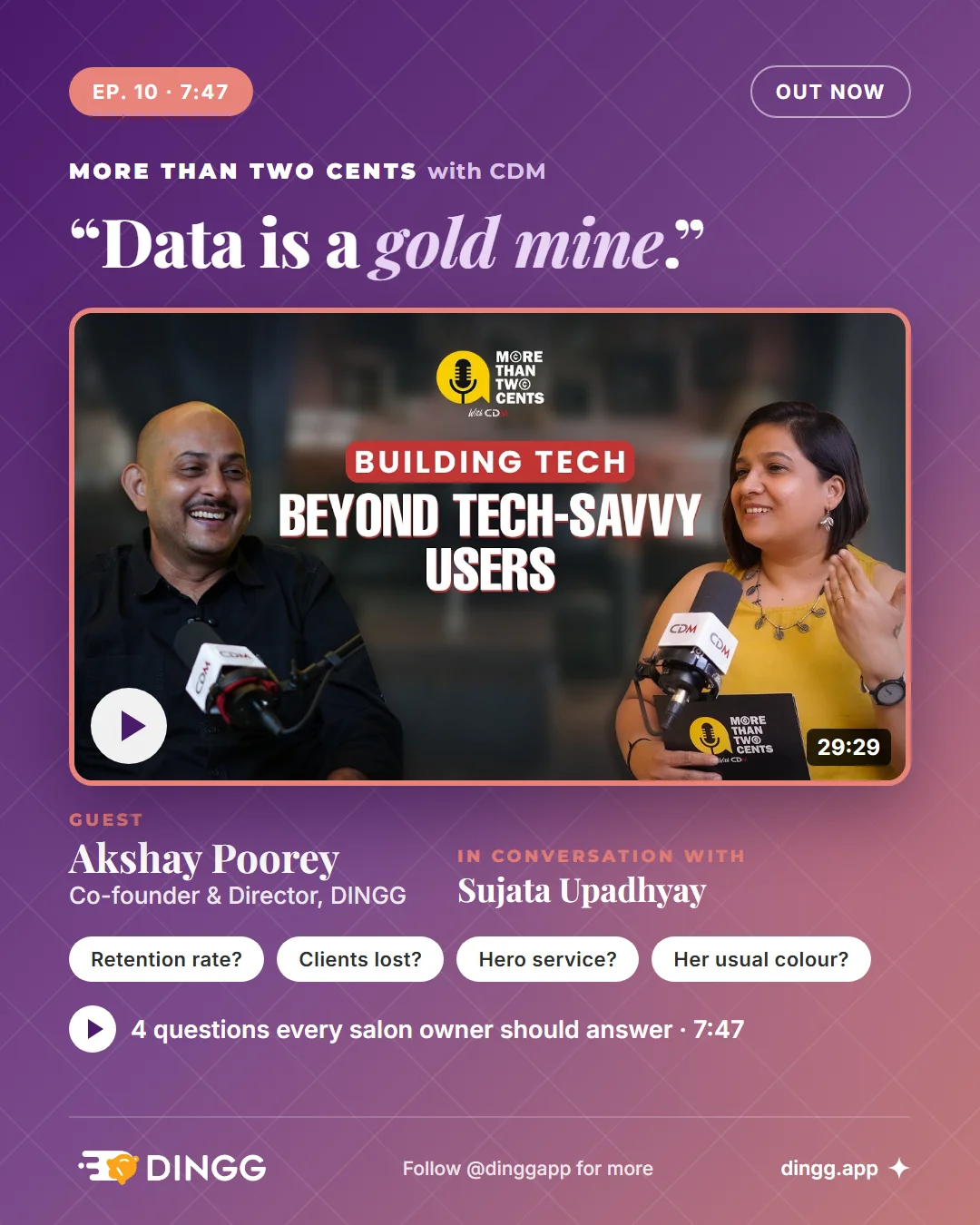
I understand why. I recently talked about exactly this with Sujata Upadhyay on Episode 10 of More Than Two Cents with CDM. Her question was simple: how do you convince people who don't see themselves as tech-savvy that they need technology at all?
My answer is that I don't try to convince them. I ask four questions.
Watch the full conversation

▶ Watch the full episode on YouTube
This episode of More Than Two Cents with CDM is hosted by Sujata Upadhyay, founder of CDM Media Group. You can also listen on Spotify. If you like conversations with people building businesses in India, subscribe to the show.
Key moments:
1:50 Why salons? It started with a waiting-time problem
3:22 From a queue-management idea to salon and spa software
4:15 One salon software for a single-chair parlour and a multi-outlet chain
7:47 "Excel works fine." The questions that change an owner's mind
11:12 How credibility gets built: beta salons, referrals, beauty events
16:13 Why our first US launch didn't work, and what fixed it
23:45 Salon software explained without the word "software"
24:31 The advice I'd give my younger self
27:00 Why salon software shouldn't be taxed like a luxury
Why do salon and spa owners say they don't need software?
Because the current system feels like it works. A diary, WhatsApp and an Excel sheet get today's appointments done. What they don't show is what's quietly leaking: clients who never came back, the services carrying the business, and years of client history nobody can look up. You can't miss data you've never had.
When we started DINGG, we made the same assumption most people make about this industry: that salons were doing their best with paper and Excel, and that a booking problem was the main thing to fix. Spending time inside salons proved us wrong. Bookings were rarely the real problem. As I told Sujata, "It's not a big problem for them. The problem is digitalisation."
There's another blind spot. Ask a salon owner what they need and most will say "more new customers." In the rapid-fire round I said they don't, and I meant it. What most salons need first is to keep the customers they already have. That's very hard to manage without data.
And this isn't a niche business. You might visit a doctor every six months, but you visit a salon every month. Grooming is a basic need, and a business people visit that often deserves proper systems.
The 4 questions every salon owner should be able to answer
These four questions show whether your salon is running on information or on memory. If you can answer all of them in under a minute, your current setup may be fine. If you can't, you're making decisions without the numbers that matter most for repeat business, revenue and client loyalty.
1. What is your client retention rate?
What it tells you: of the clients who visited in the last few months, how many came back? Retention is the clearest sign of whether your service, pricing and follow-ups are working. A salon that's busy on Saturdays can still be losing regulars every month.
How salon software answers it: every visit is recorded against a client profile, so returning versus one-time clients is calculated for you. Real-time reports show the trend without anyone updating a spreadsheet. For the weekly numbers worth checking, see 5 Reports Every Salon Owner Should Track Weekly.
2. How many clients did you lose last month?
What it tells you: lost clients rarely announce themselves. They simply stop booking. If you can't name them, you can't win them back.
How salon software answers it: customer segmentation lists clients who haven't returned within a period you choose. You can then send them a targeted WhatsApp, SMS or email campaign instead of a generic broadcast to everyone.
3. Which service is your hero service?
What it tells you: every salon has services that bring people in and keep them coming back. Knowing yours tells you what to promote, what to price carefully and which skills to build in your team.
How salon software answers it: sales by service, by staff member and by period sit in your reports. Many DINGG salon owners get their daily report by email, so they see the day's numbers before they close.
4. When a regular asks for "the same colour as last time", do you remember it?
What it tells you: this is the question that wins most owners over. If the answer lives in one stylist's memory or an old diary, it leaves when that stylist does.
How salon software answers it: a client profile stores visit history, preferences and notes such as colour formulas or allergies. Anyone at the front desk can look them up in seconds, and the client feels remembered, which is exactly what brings people back.
This is why I say, "Data is a gold mine. In an Excel sheet you can't maintain five years of data, but in software you can." With proper records you can compare this year with last year, see how each staff member is performing, and spot problems while they're still small.
Salon software vs Excel vs pen and paper: what's the difference?
Excel and pen and paper record what someone remembers to write down. Salon software records what actually happens: every booking, bill and visit, automatically. It then acts on that data by sending reminders, flagging lost clients and building reports. Spreadsheets can calculate, but only after someone has entered the data by hand.
What you need | Pen and paper / diary | Excel sheet | Salon software |
|---|---|---|---|
Take bookings | Phone calls and walk-ins, written by hand | Typed in after the fact | 24/7 online and WhatsApp booking |
Reduce no-shows | Manual calls, if someone remembers | Manual calls | Automatic reminders and confirmations |
Client history ("same colour as last time") | Scattered across diaries | One row per visit, hard to search | Full profile with visits, preferences and notes |
Retention and lost clients | Not visible | Possible with a lot of manual work | Calculated automatically |
Hero service and sales by service | Guesswork | Manual totals | Built-in reports |
Staff commissions and performance | Calculated by hand at month end | Formulas that break | Tracked per bill |
GST billing and UPI payments | Handwritten bills | Separate invoicing | GST-ready invoices with UPI, cards and wallets |
Years of data, year-on-year comparison | Not practical | Becomes unwieldy | Kept and searchable |
Works on your phone | No | Partly | Mobile, tablet and desktop |
Spas face the same trade-off with an extra layer of packages and room bookings. We broke down the real cost in What Running Your Spa on WhatsApp and Paper Really Costs.
What should good salon and spa software do?
It should run your daily operations and help you grow at the same time. That means taking bookings around the clock, reminding clients, remembering their history, billing correctly, tracking staff and stock, and turning all of that into reports and campaigns. It should also be simple enough that your team uses it every day.
Here's the checklist I'd use, whatever software you choose:
Bookings that don't depend on someone answering the phone. 24/7 online booking, and DINGG AI Genius, which lets clients book on WhatsApp even when your salon is closed.
A calendar for staff and rooms. Smart scheduling with drag-and-drop appointments.
A system for no-shows. As I said on the show, "How can I reduce no-shows? You can't do it with pen and paper or an Excel sheet. You need a system in place. You need workflows." Automatic reminders are the simplest place to start.
Client profiles with history, preferences and notes (see how).
Billing that's ready for India. GST-ready invoices with UPI, card and wallet payments.
Staff management. Attendance, commissions, goals and performance in one place (staff management).
Inventory alerts before you run out mid-service (inventory control).
Ways to bring clients back. Loyalty rewards, memberships and targeted WhatsApp campaigns.
Reports you'll actually read, daily if you want them.
See how this comes together for salons and for spas.
Does a single-chair parlour need the same software as a salon chain?
No. Their needs are very different, which is why salon software should be configurable. A single-chair beauty parlour may only need to know who's coming tomorrow and send reminders, all from a phone. A multi-outlet chain needs marketing, staff, inventory and reports across every branch.
We learned this early. Beauty parlours, unisex salons, premium outlets and chains all use the same industry words, but they work very differently. So we built DINGG to be configured rather than one-size-fits-all. It runs on a mobile phone, a tablet or a desktop, and you switch on only what you need.
If you run several branches, look for one dashboard across all locations with pricing per branch (multi-location management). If you're not sure where you stand, 10 Signs Your Salon Needs a Digital Upgrade is a good self-check.
How do you get your team to actually use salon software?
Treat it as a habit, not a one-day installation. Start with the task that hurts most, usually bookings and reminders, and add billing and reports once the team is comfortable. Choose software that's easy to use, train everyone properly, and let the daily reports show the team why it's worth it.
Sujata made a fair point on the show: convincing an owner is one thing, but getting a team to change how it works every day is another. What has worked for our customers:
Start with one workflow. Move bookings and reminders first, so the front desk sees the benefit within days.
Make it easy. Our first beta salons stayed with DINGG mainly because it was easy to use, and that still matters more than any feature list.
Train people properly. I spend time with beauty and skin training institutes asking them to teach salon software alongside technical skills. The earlier people learn it, the more natural it feels.
Share the numbers. When staff can see their own bookings and commissions, they want the system to be right.
What I learned building DINGG
Talk to customers before building, build with the industry rather than for it, and don't assume what works in one country will work in another. Those three lessons shaped DINGG, from a queue-management idea into salon and spa management software used in 18 countries.
We started by solving the wrong problem. DINGG began as a queue-management product, because waiting at salons on weekends looked like the big problem (1:50). It wasn't. In the rapid-fire round I said, "If we had known they needed software, we could have saved around six to eight months" (24:31).
We built it with the industry. "We built it with the industry. It was not sitting inside a room and deciding what salons need." Beta customers, then referrals, then beauty-industry events. We still set up booths to meet owners and hear what we should improve, not just to sell (11:12).
What works in India doesn't automatically work in the US. "We miserably failed initially in the US, because our product was not a market fit." US salon owners worked mainly on apps, their UX expectations were different, and our iOS app needed work. Going to US beauty events, rebuilding the experience and working with local partners turned it around (16:13).
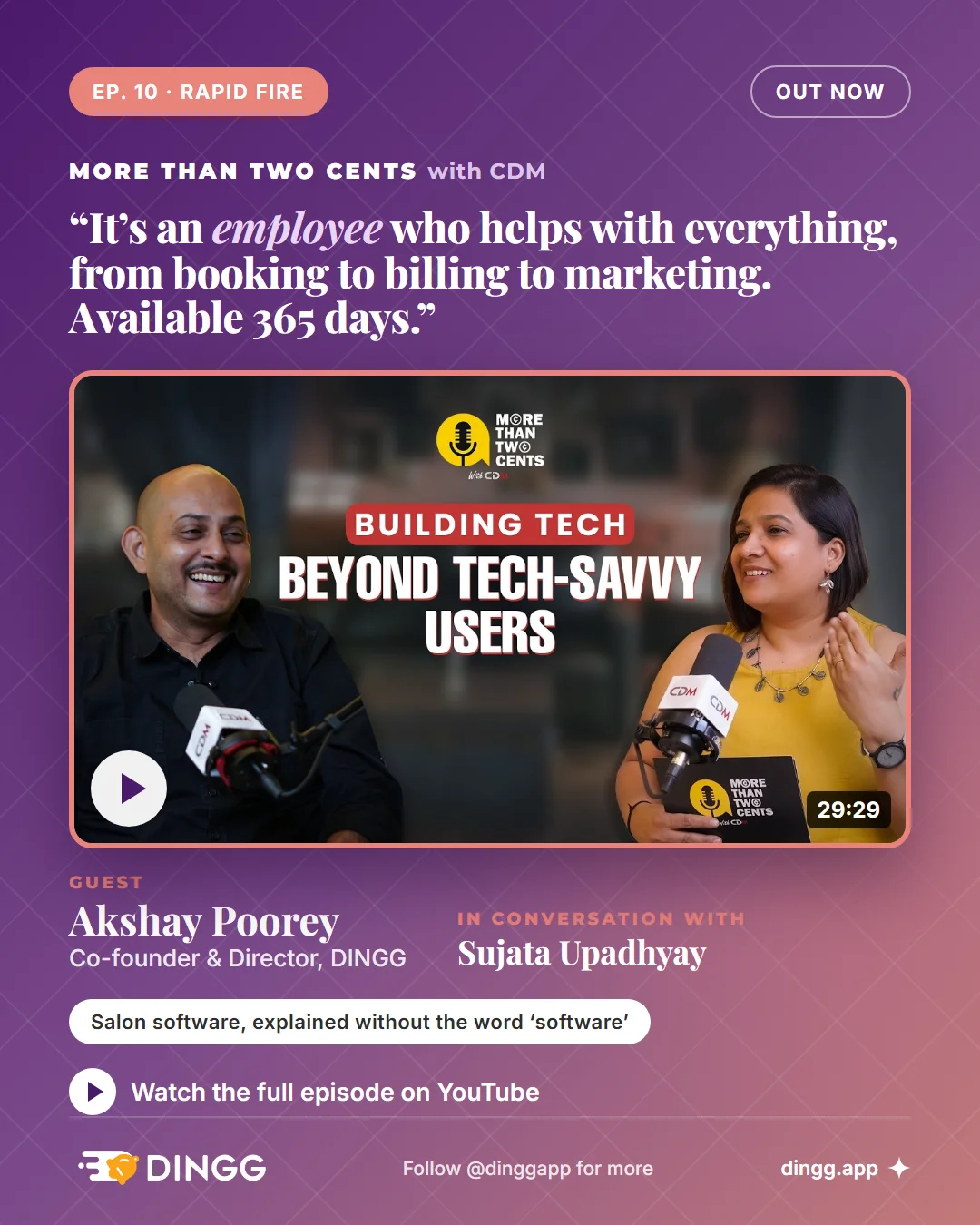
And when Sujata asked me to explain DINGG without saying "software", "AI" or "technology", this is what I said: "It's an employee who helps you in every aspect, from booking to billing to marketing to analytics, available 365 days, without asking for a salary hike" (23:45).
Transcript excerpts
Lightly edited for readability from More Than Two Cents with CDM, Ep. 10. Watch the full episode on YouTube or listen on Spotify.
"Excel works fine for my salon" (7:47)
Sujata Upadhyay: Did you have a situation where salon and spa owners said, "Everything is working fine, we don't need technology, the Excel sheet works"? How did you convince people who aren't tech-savvy?
Akshay Poorey: It happens all the time. A lot of people in the industry still use pen and paper, and a few use Excel sheets. Convincing them doesn't take a lot of effort, because we start by asking: tell me, what is your retention rate? How many customers did you lose last month? How much new business did you get? Which service is your hero service? If a client comes in and asks for the same colour as last time, do you remember it? You don't. These are the things they miss: the analytics, the customer profile. Because data is a gold mine. In an Excel sheet you can't keep five years of data, but in software you can. You can't compare last year with this year, or see how your staff are performing.
"We miserably failed initially in the US" (16:03)
Akshay Poorey: When we launched in the US, we thought it would work because it was doing great in India. But that was not the case. We miserably failed initially, because our product was not a market fit. So we started talking to customers, the same way we did in India, and going to US beauty events to understand what was going on. A lot of things are different in India and the US. They use the app more than the desktop or web version, and our iOS app was not good enough to handle all the functionality. Their UI and UX requirements were different. We worked on all of that, and now we have a good number of customers.
Salon software, without the word "software" (23:27)
Sujata Upadhyay: One assumption about salons and spas that you had to unlearn?
Akshay Poorey: That they were doing their best with Excel and paper. That was not the case, and that's how we built the software.
Sujata Upadhyay: Explain DINGG's value without using the words software, AI or technology.
Akshay Poorey: It's your employee, who helps with everything, from booking to billing to marketing to analytics. You don't need to sit and calculate total incentives. It's an additional employee that helps you manage your operations, without asking for a salary hike all the time, and it's available 365 days. Without any hassles.
Frequently asked questions
Is salon software worth it for a small salon?
Yes, if the setup matches your size. A small salon or single-chair parlour can start with bookings, client history and automatic reminders on a phone, and add billing, reports and marketing later. The test is simple: if you can't answer the four questions above, software will pay for itself in clients you keep.
What is the difference between salon software and spa software?
The core is the same: bookings, billing, client profiles, staff and reports. Spa software also needs to handle rooms and resources, longer treatments, and packages or memberships that clients use over several visits. DINGG covers both. See salon software and spa software.
Can I run my salon from my phone?
Yes. DINGG works on mobile, tablet and desktop, and has apps for Android and iOS. Many single-chair parlours run entirely from a phone: checking who's coming tomorrow, sending reminders and billing at the counter.
Can clients book salon appointments on WhatsApp?
Yes. With DINGG AI Genius, clients can book on WhatsApp at any time, including after your salon closes. It also handles confirmations, reminders and follow-ups through two-way messaging.
How much does salon software cost?
It depends on your number of outlets, staff and the features you need. A single-chair parlour and a 10-branch chain need very different setups. The quickest way to get an accurate answer for your salon is to book a free DINGG demo.
What GST applies to salon software in India?
Salon and other beauty services moved to 5% GST (without input tax credit) from 22 September 2025, but salon software is still taxed at 18%, the standard rate for software. I've been raising this with industry forums and the government, because salon software is a basic business tool, not a luxury.
Can you answer the four questions today?
If not, that's exactly what a DINGG demo walks you through: your retention, your lost clients, your hero service and your client history, all on one screen. In 30 minutes we'll show you how it would look for your salon or spa.
And if you enjoyed the conversation, subscribe to More Than Two Cents with CDM on YouTube and Spotify. Thank you, Sujata and the CDM team, for having me.
Related reading